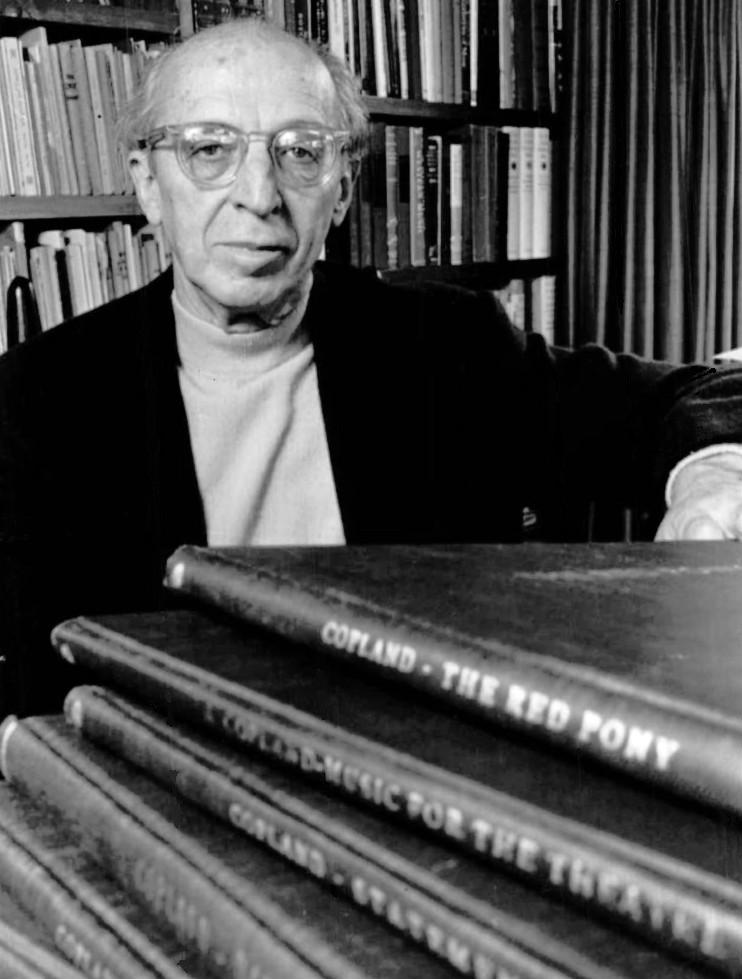
Aaron Copland
Combing through the pages of music history, you'll find a long list of composers who gave us great pieces of music: Mozart, Beethoven, Handel, and others.
The birth of the United States brought forth new composers and new styles. In the 20th century, one such composer was Aaron Copland.
His works celebrated not the elite or great people of the earth, but ordinary people through such memorable music as Appalachian Spring and Fanfare for the Common Man.
So get all dressed up, and let's step out for a night on the town to learn about Aaron Copland.
A new composer for a new century
The year 1900 opened up a new century, and was a time full of optimism for the United States.

Recent inventions such as the movies, the light bulb, telephones, and others pointed to a century of amazing new devices. America was prosperous and looking to take its full place in the world.
On November 14th of this year, Harris and Sarah Copland welcomed their 5th child, a son, to their home.
Young Aaron was born.
Aaron's family was one of faith and music; he grew up in a conservative Jewish family and had a mother and two of his older siblings who were into music. His older sister, Laurine, taught him piano and, as a student at the opera school, brought home music for him.
Most of his early music exposure was at weddings and other religious ceremonies, but he was also exposed to opera and loved it. Early in his life, this exposure helped develop in him an interest in music, including composing it – he composed his first music when he was eight years old.
Making music would be his life. Throughout his school days, he received music lessons (including music composition) up through high school. After school, his father wanted him to go on to college, but agreed to let him go to Paris to focus on his music. He ended up learning under Nadia Boulanger.
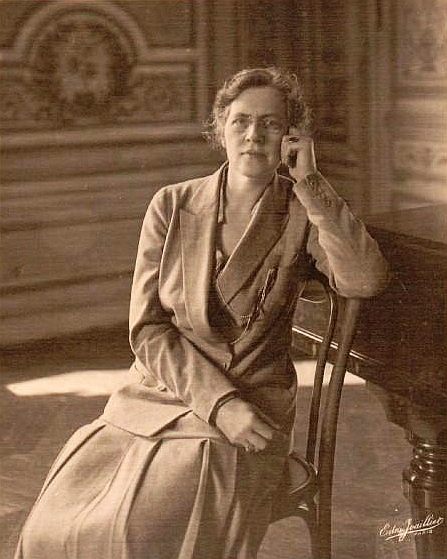
She quickly saw his talent.
An American composer
Copland returned to New York in the 1920s, eager to begin his career. But life for a young, unknown composer is not easy – requiring him to get by as best he could. Throughout the 20s, he began to feel his work was too artsy, too abstract.
Then the Great Depression of the 30s hit, and so many people fell on hard times.
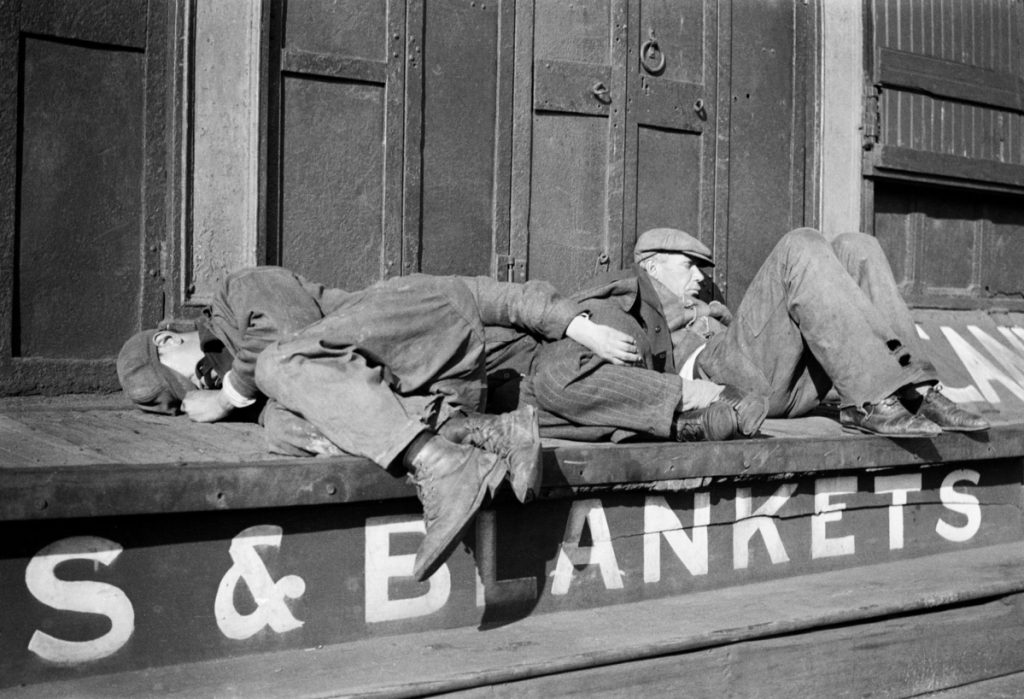
With money scarce, Copland's music didn't sell well at all. Again, he felt it was too "artsy." His solution, compose music celebrating the everyday American and American culture.

Workers taking a lunch break in the 1930s.
Aaron Copland found his life's work.
His works
Copland produced music that reinforces the ideal that everyone has value. Everyone – from Shakers to cowboys to outlaws – has a story to tell us.
Check out some of his works:
Billy the Kid (1939) – A ballet celebrating the famous outlaw.
Fanfare for the Common Man (1942)
Rodeo (1942) – A ballet celebrating the West.
Appalachian Spring Suite (1945) – Music inspired by Shaker hymns and includes Simple Gifts.
These popular-themed songs brought him some criticism from those in more elite circles. Some felt this approach cheapened or "dumbed down" classical music.
That didn't stop him. He kept right on.
He also composed film scores (music that goes in a movie) for the following movies:
Of Mice and Men (1939)
The City (1939)
Our Town (1940)
The North Star (1943)
The Red Pony (1949)
The Heiress (1949)
Something Wild (1961)
And more
Aaron Copland was more than just about writing music. He used his position to teach and encourage young and up-and-coming composers. Many a young composer benefited from his lectures and little pieces of advice.
He made his contribution to the future.
Lastly, he wrote about music and critiqued what was being produced. He never really saw himself as a writer. Instead, it was, as he put it, "a byproduct of my trade," a "kind of salesman for contemporary music."
Teacher, writer, and composer of positive music celebrating common people like you and me.
Not a bad contribution to our world.
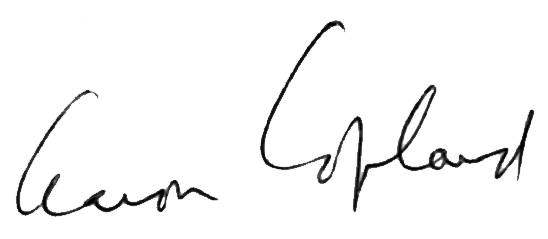
Aaron Copland's signature
On the web
Some of Aaron Copland's works can be enjoyed online. Here are some examples.
Copland Conduct Hoedown from Rodeo
This is a recording from a 1976 TV broadcast where Copland himself conducts the music.
Copland: Variations on a Shaker Melody from “Appalachian Spring”
Here, students of The Rivers School Conservatory perform a segment from the Appalachian Spring Suite inspired by the Shaker song “Simple Gifts.”
I'd love to hear from you. Feel free to email me.
Don't miss out on future posts! Sign up for our email list and like us on Facebook!
Check out more hot topics, go back to Home Page

Comments? You can contact me at mailbox@thehomegrownprofessor.com